

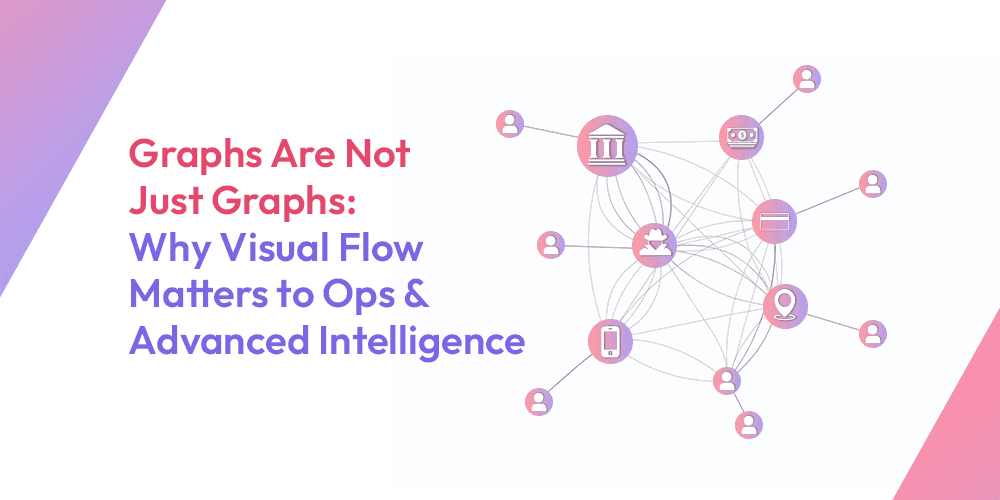
Graphs Are Not Just Graphs: Why Visual Flow Matters to Ops and Advanced Intelligence

RaptorX.ai
Sunday, January 11, 2026
When Data Exists, but Insight Doesn’t
Most modern organizations already have more data than they can act on. Transactions, accounts, devices, users, merchants, everything is logged, timestamped, and stored. Yet fraud continues to scale, false positives remain high, and operations teams are overwhelmed.
The issue is not data availability.The issue is how that data is represented and interpreted.
Traditional systems treat risk as a series of isolated events. But real-world behavior, especially financial crime, does not occur in isolation. It moves. It connects. It evolves.
This is where graphs stop being “just graphs” and start becoming operational instruments.
Why Traditional Risk Views Break at Scale
Event-Based Thinking Misses Networked Behavior
Legacy rule engines and tabular dashboards are optimized for single-event evaluation:
- One transaction
- One account
- One threshold breach
This approach struggles with:
- Mule account networks
- Synthetic identity rings
- Layered transaction paths
- Coordinated low-value fraud spread across entities
Each individual action appears normal. The risk only becomes visible when relationships are viewed together.
High False Positives Are a Structural Problem
Operations teams are not overwhelmed because they lack skill. They are overwhelmed because their tools lack context.
When systems do not understand:
- how entities relate,
- how funds move across hops,
- how behavior propagates across accounts,
they compensate by raising alerts aggressively. The result is alert fatigue, slower investigations, and missed true risk hiding in plain sight.
What a Graph Actually Represents in Operations
A graph is not a visualization layer. It is a structural model of reality.
In a financial or operational environment, a graph represents:
- Nodes: accounts, users, devices, merchants, identities
- Edges: transactions, shared attributes, behavioral links
- Paths: movement of value, access, or intent over time
This structure mirrors how fraud and abuse actually operate: not as spikes, but as flows.
Visual Flow: The Missing Layer Between Data and Decisions
Seeing Movement, Not Just Metrics
Visual flow shows:
- how funds traverse multiple accounts,
- how devices link seemingly unrelated users,
- how repeated low-risk actions form high-risk patterns.
This is not about making charts prettier. It is about exposing causality.
An analyst does not need another score.They need to see why something matters.
Multi-Hop Visibility Changes Outcomes
Most sophisticated financial crime spans multiple steps:
- Account A funds Account B
- Account B transacts with Merchant C
- Merchant C routes funds externally
Each step alone looks compliant.The path does not.
Graph-based flow surfaces these paths instantly, allowing teams to:
- prioritize investigations accurately,
- reduce time spent validating false alerts,
- Focus on structural risk rather than surface anomalies.
Operational Impact: Why This Matters to Real Teams
Faster Investigations, Not More Alerts
When investigators can visually trace relationships:
- cases close faster,
- The evidence is clearer,
- Escalation decisions are grounded in facts, not assumptions.
This directly reduces operational cost and improves throughput.
Explainability That Stands Up to Scrutiny
Regulated environments demand more than detection; they demand justification.
Graph-based flow provides:
- traceable entity relationships,
- transparent reasoning paths,
- audit-ready explanations without manual reconstruction.
This is critical for compliance reviews, regulatory audits, and internal governance.
Real-Time Context, Not Retrospective Guesswork
Modern financial systems operate continuously. Risk cannot be assessed days later.
By evaluating relationships as they form, graph-based systems:
- detect emerging patterns early,
- prevent downstream exposure,
- adapt as behavior changes rather than relying on static definitions.
This is especially relevant in high-velocity environments such as digital payments, cross-border transactions, and real-time settlement systems.
Reducing Noise Without Losing Coverage
One of the most practical advantages of graph-driven flow analysis is signal refinement.
Instead of asking:
“Does this transaction look risky?”
The system asks:
“Does this transaction participate in a risky structure?”
This shift alone:
- lowers false positives,
- preserves detection coverage,
- aligns alerts with meaningful action.
Why Visualization Is Not Optional
Some organizations treat visualization as a reporting layer added after detection. That is a mistake.
Visualization is:
- how analysts build intuition,
- how teams collaborate,
- how complex behavior becomes understandable.
Without clear visual flow:
- insights stay buried in logs,
- investigations become manual,
- Expertise does not scale across teams.
The Practical Reality: Graphs Require Discipline
Graphs are powerful, but they are not magic.
They require:
- clean entity resolution,
- well-defined relationship logic,
- thoughtful visual design that supports decision-making rather than overwhelming it.
When implemented correctly, they enhance human judgment rather than replacing it.
What This Means for the Future of Operations
As transaction volumes grow and behavior becomes more distributed, static views will continue to fail.
Organizations that succeed will be those that:
- model relationships, not just events,
- prioritize flow over snapshots,
- Equip teams with tools that reflect how risk actually behaves.
Graphs are not an emerging concept.They are becoming the default language of operational clarity.
From Data to Understanding
The most valuable systems are not those that generate the most alerts, but those that generate the clearest understanding.
Graphs, when used to expose visual flow, bridge the gap between raw data and confident action. They turn complexity into structure and noise into narrative.
And in modern operations, that difference is not academic. It is decisive.