

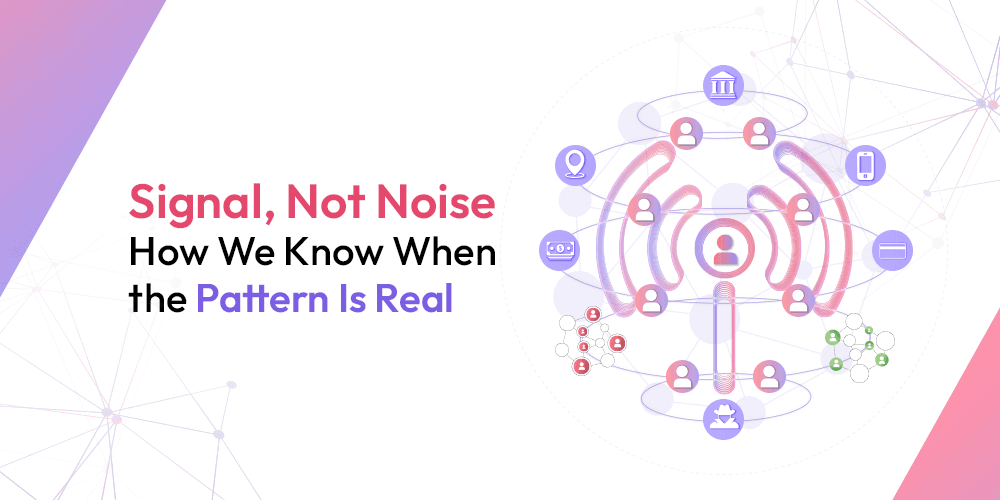
Signal, Not Noise: How We Know When the Pattern Is Real

RaptorX.ai
Monday, January 5, 2026
Why “More Alerts” Is Not the Same as Better Insight
Modern fraud and financial crime do not fail because institutions lack data. They fail because too much of that data is interpreted in isolation.
Transaction volumes are higher than ever. Channels are fragmented. Customer behavior is fluid. Yet many detection systems still rely on static thresholds and point-in-time checks. The result is predictable: an overwhelming volume of alerts, most of which represent noise rather than true risk.
The real challenge today is not finding anomalies, but knowing when an anomaly represents a meaningful pattern, a signal that points to coordinated, intentional behavior rather than coincidence.
This paper explores how real patterns emerge, why traditional approaches struggle to identify them, and what distinguishes defensible signals from operational noise.
1. The Fundamental Problem: Events vs. Patterns
Events Are Easy to Flag
Patterns Are Hard to Prove
An unusually large transaction. A rapid sequence of transfers. A login from a new device. Each of these can be flagged in isolation, and often is.
But single events rarely tell the full story. Financial crime today is rarely opportunistic. It is structured, distributed, and designed to look ordinary at the surface level.
A real pattern only becomes visible when we examine:
- Relationships between entities
- Behavior over time
- Context across channels and systems
Without this broader view, systems tend to confuse volume with insight.
2. Why Legacy Detection Systems Create Noise
Static Rules in a Dynamic World
Rule-based systems were designed for a simpler environment, one where fraud followed predictable paths. Today, those same rules suffer from three structural limitations:
1. Threshold Blindness
Fixed limits (amount, frequency, velocity) fail to account for:
- Customer-specific behavior
- Regional norms
- Seasonality or lifecycle changes
What is risky for one account may be routine for another.
2. Siloed Evaluation
Transactions, identities, devices, and counterparties are often evaluated separately. This prevents the system from recognizing coordinated activity across multiple nodes.
3. Alert Inflation
As rules multiply, false positives scale faster than true detections, leading to:
- Analyst fatigue
- Slower response times
- Missed high-risk cases buried in volume
Noise becomes the dominant output.
3. What Defines a “Real” Pattern?
A real pattern is not defined by rarity alone. It is defined by structure and intent.
Three Characteristics of a True Signal
1. Relational Consistency
The same entities repeatedly appear together across transactions, accounts, devices, or beneficiaries, often across indirect links.
This is where fraud rings, mule networks, and layering schemes reveal themselves.
2. Behavioral Deviation
The activity deviates meaningfully from established historical behavior—not just in size, but in:
- Timing
- Counterparty selection
- Flow direction
- Channel usage
The key question is not “Is this unusual?” It is “Unusual compared to what this entity normally does?”
3. Temporal Narrative
Real patterns unfold in stages:
- Setup
- Testing
- Scaling
- Exit
When activity is viewed as a sequence rather than isolated points, intent becomes clearer.
4. From Isolated Data to Connected Understanding
Why Relationships Matter More Than Individual Transactions
Financial crime is increasingly network-based. One account may look clean. Ten accounts viewed together may tell a very different story.
By connecting:
- Accounts
- Transactions
- Devices
- Identities
- Merchants or counterparties
We begin to see structures, not just spikes.
Examples include:
- Circular fund movements
- Fan-in / fan-out transaction flows
- Shared infrastructure across otherwise unrelated accounts
These structures rarely trigger alarms in traditional systems, but they are strong indicators of organized behavior.
5. The Role of Behavioral Baselines
Context Turns Anomalies into Insight
A $50,000 transfer is meaningless without context. For some entities, it is routine. For others, it is a clear deviation.
Behavioral baselines allow systems to evaluate risk relative to:
- Historical transaction patterns
- Frequency norms
- Typical counterparties
- Usual operating hours or geographies
This approach reduces false positives while surfacing subtle but meaningful shifts, often before losses occur.
6. Why Explainability Is Not Optional
Detection Without Explanation Is Operationally Useless
For regulated environments, identifying risk is only half the job. Institutions must also be able to answer:
- Why was this flagged?
- What behavior triggered concern?
- How does this align with policy and regulation?
Clear, traceable explanations:
- Improve analyst confidence
- Accelerate case resolution
- Support audits and regulatory reviews
A signal that cannot be explained will not survive scrutiny, no matter how accurate it may be.
7. Real-World Patterns That Noise Often Hides
Mule Networks
Individually low-risk accounts reveal structured behavior when viewed as a group, shared endpoints, synchronized transfers, or common upstream sources.
Synthetic Identity Activity
Identity elements may pass individual checks, but their relationships across systems expose inconsistencies that point to fabrication rather than coincidence.
Layered Laundering
Funds moving through multiple accounts in controlled steps often evade single-transaction rules but become obvious when flow paths are analyzed end-to-end.
Trade and Cross-Border Schemes
Over- and under-invoicing, repeated counterparties, and mismatched flows only surface when trade, payment, and ownership data are evaluated together.
8. From Noise Reduction to Better Decisions
The goal is not to eliminate alerts. It is to increase confidence in the alerts that remain.
When systems focus on:
- Relationships over isolation
- Behavior over thresholds
- Narratives over snapshots
The output shifts from operational noise to actionable intelligence.
Knowing When the Pattern Is Real
Signal is not about volume. It is about coherence.
A real pattern is one that:
- Persists across time
- Connects entities in meaningful ways
- Deviates from established behavior
- Can be clearly explained and defended
In an environment where fraud evolves faster than static controls, the institutions that succeed will be those that move beyond counting alerts and start understanding patterns.
Because in modern risk management, clarity is the competitive advantage.