

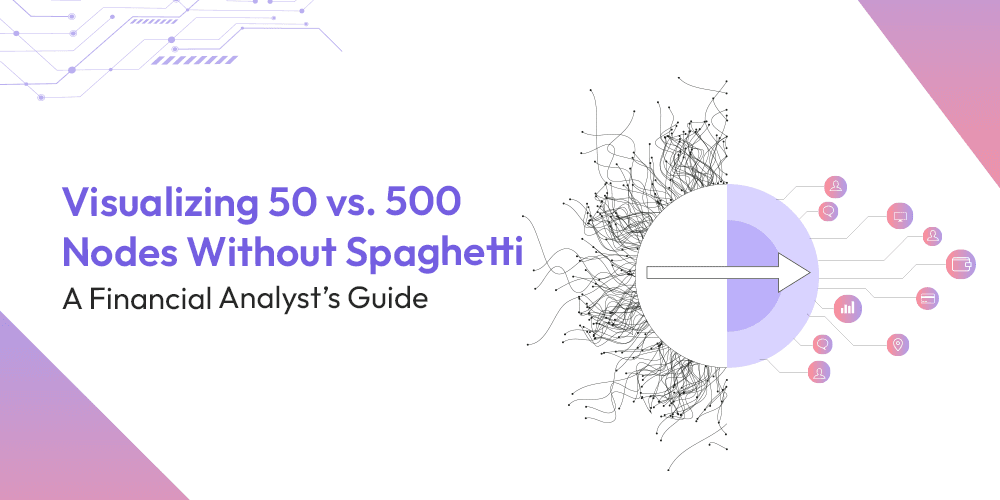
Visualizing 50 vs. 500 Nodes Without Spaghetti: A Financial Analyst’s Guide

RaptorX.ai
Friday, October 24, 2025
In financial fraud detection, spotting patterns quickly can mean the difference between preventing losses and becoming a victim. Yet as data grows, visualizing complex networks, from 50 to 500 interconnected nodes, presents a unique challenge: graphs can become tangled and confusing, a phenomenon often called "spaghetti visualization."
The Challenge: Clarity vs. Complexity
For financial institutions, clarity in data visualization is essential. Small datasets with 50 nodes are relatively easy to interpret. But as networks expand to 500 nodes or more, analysts face:
- Overlapping Connections: Dense graphs hide important relationships.
- Signal Dilution: Key fraudulent behaviors can be buried under irrelevant connections.
- Analyst Fatigue: Excessive visual complexity slows decision-making and increases errors.
RaptorX’s Approach: Human-Centered Graph Intelligence
RaptorX addresses these challenges with solutions that combine real-time graph analytics and usability-focused design.
Adaptive Graph Layouts
Dynamic layouts adjust automatically depending on node density. Whether handling 50 or 500 nodes, the visualization remains readable, highlighting important relationships without overwhelming the analyst.
Hierarchical Clustering
RaptorX groups related nodes into clusters. Analysts can focus on suspicious clusters first and expand for deeper investigation, reducing visual clutter while preserving critical context.
Progressive Disclosure
Not all information is shown at once. Key patterns are surfaced first, and additional details are revealed as analysts explore specific areas, keeping attention on the most relevant data.
Interactive Filters and Contextual Insights
Analysts can filter data by transaction type, account behavior, or risk score. Contextual tooltips provide on-demand insights into node relationships, eliminating the need to interpret dense visuals without support.
Real-Time Updates
As transactions and account activity evolve, RaptorX updates visualizations in real-time, ensuring analysts are always working with current information.
Infrastructure Designed for Scale
Scalable visualization requires robust infrastructure:
- Distributed Graph Processing: Handles large datasets efficiently.
- Optimized Graph Databases: Provides quick retrieval of relevant connections.
- Load Balancing and Caching: Maintains performance during peak usage.
Why Analyst-Centric Design Matters
At RaptorX, visualization is more than a display; it’s a tool for action. By prioritizing usability and scalability, analysts can detect mule rings, synthetic identities, and coordinated fraud patterns faster and with higher accuracy.
Conclusion
Visualizing 50 vs. 500 nodes without creating spaghetti requires a careful balance of UX, infrastructure, and intelligent clustering. With RaptorX’s human-centered design, financial institutions can maintain clarity and efficiency, transforming complex networks into actionable insights.